If you’ve spent any time in manufacturing IT, you’ve probably lived through the same story more than once.
A machine gets connected. Data flows into a historian or a SCADA system. A dashboard gets built. Everyone is happy for a while.
Then the next request shows up.
“Can we send this to the cloud?”
“Can we combine this with MES data?”
“Can we compare performance across plants?”
And suddenly the simple integration becomes a complicated project.
The hard part is rarely getting data out of machines. We already have plenty of protocols and tools for that.
The hard part is making data mean the same thing everywhere.
Every plant has its own naming conventions, its own legacy systems, and its own way of structuring data. Over time, integrations pile up. Custom connectors get written. Scripts get added. Documentation gets lost.
Six months later the system works. Two years later nobody wants to touch it.
That cycle is why I started paying attention to CESMII and the i3X initiative. Not because it is another platform announcement. Actually the opposite. The goal is to stop rebuilding integration logic every time a new application appears.
And honestly, that is the right problem to focus on.
What Is CESMII i3X?
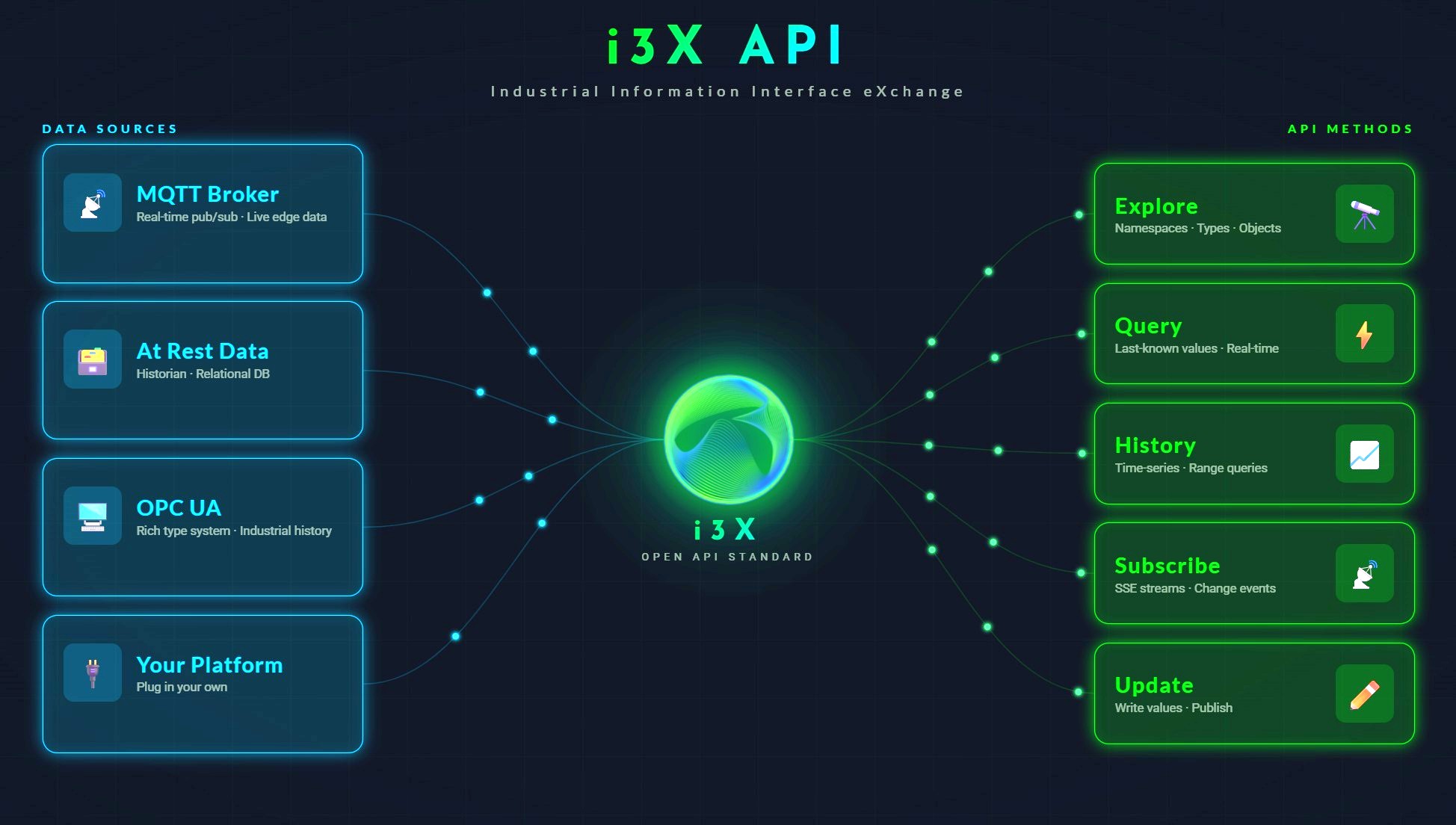
i3X stands for Industrial Information Interoperability eXchange.
At a practical level, it is an open API specification designed to access contextualized manufacturing data in a consistent way.
Think of it as a common contract. Applications build once against the i3X API. Then they can run on any backend that supports the standard.
Instead of writing a new connector for every historian, MES system, or data platform, applications interact with the same interface.
The idea is simple. Make integration predictable and portable.
The CESMII ecosystem, which includes vendors, system integrators, and manufacturers, built i3X to address a growing problem. As factories adopt more digital platforms, the number of proprietary APIs keeps growing.
In the past the fragmentation happened at the protocol level. Today it is happening at the API layer.
i3X is an attempt to slow that fragmentation down.
Why This Matters in Real Plants
Most manufacturing environments are brownfield.
Plants run equipment that has been evolving for decades. PLC code was written by multiple teams across different years. Historians were deployed for specific projects. Databases were built to solve local problems.
When a new analytics platform or AI application arrives, the integration work starts from scratch.
Data has to be mapped again. Context has to be recreated. Custom code gets written. Everyone hopes nothing breaks when upgrades happen.
Now multiply that problem across multiple sites.
Scaling digital transformation becomes almost impossible if every integration is unique.
i3X is designed to act as a common API layer on top of existing systems. It does not replace historians, SCADA platforms, or data brokers. It simply standardizes how those systems expose structured information.
That approach makes integrations repeatable.
And repeatability is what allows programs to scale beyond the first pilot.
The Real Problem. Meaning
Connectivity is not the main challenge anymore.
Plants already have OPC UA servers, MQTT brokers, REST APIs, and various data pipelines. Data can move almost anywhere.
The real problem is meaning.
You can have five plants connected to the same data platform and still be unable to answer a simple question like:
“Show me OEE for all fillers across all sites.”
The reason is usually semantic inconsistency.
One site might store a tag called:
Line1.Filler.SpeedAnother site might call the same concept:
FLR_01.SPD_ACTA third site may use a historian tag created years ago with a naming convention nobody remembers anymore.
Even worse, the word “Speed” may represent completely different things.
It could mean the setpoint.
It could mean the actual measured value.
It could mean the rated capacity stored in an equipment master table.
Without shared context, the data platform becomes a very expensive junk drawer.
i3X tries to address that by focusing on interoperable information models, not just connectivity.
In simple terms. It encourages defining what a data point represents, not only where it came from.
How i3X Works
Technically, i3X is a REST-based API specification.
It is open source, distributed under an MIT license, with public documentation and reference implementations.
The API allows applications to discover data structures, relationships, and values. That includes both current and historical information.
It is intentionally technology-neutral. Developers can use Python, Java, Go, or any language capable of calling REST APIs.
i3X is also designed to sit alongside existing industrial protocols.
OPC UA provides rich modeling capabilities, alarm handling, and structured events. However, implementing full OPC UA information models can be complex and heavy for some environments.
i3X aims to provide a simpler interface that exposes contextualized information without requiring a full OPC UA server implementation.
MQTT handles event-driven data distribution extremely well. But it does not define discovery, structure, or historical queries.
i3X can complement MQTT by providing those missing pieces.
The point is not to replace existing technologies. The point is to connect them through a consistent interface.
What i3X Gets Right
1. It Treats Meaning as a First-Class Problem
Many integration projects begin with connectivity.
Choose a protocol. Connect devices. Publish messages.
That step is necessary. But it does not solve interoperability.
Real interoperability requires shared definitions. Equipment states, production rates, downtime reasons, and batch identifiers all need consistent meaning.
i3X pushes teams to define those semantics.
If that sounds obvious, it is because the industry has known this problem for years. The difference is that i3X tries to operationalize it through a usable API.
My honest opinion. If you do not address semantics early, your data platform will eventually collapse under inconsistency.
2. It Keeps the Model Practical
One design choice in i3X is simplicity.
For example, complex object structures can be flattened into a namespace that is easier for applications to consume. That reduces some of the modeling depth you might get in OPC UA.
But the trade-off is usability.
In many plants, the biggest challenge is not missing features. It is the operational complexity of maintaining those features.
A simpler interface that works reliably often wins over a perfectly modeled system that nobody understands.
3. It Encourages Model-Based Integration
Many integration projects still rely heavily on spreadsheets.
Engineers export tag lists. Someone maps those tags to a standard naming convention. The spreadsheet becomes the “documentation.”
This approach works until something changes.
And something always changes.
A PLC gets replaced. A line gets upgraded. A controls engineer cleans up tag names. Suddenly the mapping spreadsheet is outdated.
Model-based approaches scale better.
Models can be versioned. They can be validated automatically. They can be reused across sites. They can also be tested.
That last point is important.
You can verify that a required data point exists. You can check that it updates within expected intervals. You can validate data types and ranges.
That moves data engineering away from “the dashboard looks right” toward something closer to software engineering discipline.
4. It Aligns with How Plants Actually Evolve
Factories are not static environments.
Equipment gets replaced. Firmware changes. Maintenance teams modify control logic. Production introduces new products that break previous assumptions.
Any interoperability strategy has to survive constant change.
i3X encourages scalable modeling patterns instead of one rigid structure.
In practice many programs end up using layered models.
One layer matches how the controls systems represent the equipment. This layer stays close to the operational environment.
Another layer standardizes information for enterprise analytics and cross-site comparisons.
That separation helps maintain local flexibility while preserving enterprise consistency.
5. It Supports the Unified Namespace Concept
The Unified Namespace idea is simple.
Operational data is published into a structured namespace so systems can subscribe and consume it consistently.
In practice this concept sometimes gets simplified into “publish everything to MQTT.”
That approach can create noise quickly.
A pump might publish hundreds of signals. If none of them clearly represent “Run Status,” analytics teams may choose the wrong signal.
Then the debate begins about why dashboards show incorrect results.
The problem is rarely the analytics logic. It is ambiguity in the data.
i3X helps by providing structured access to contextualized information. Instead of a raw stream of tags, applications can query structured data entities with defined meaning.
That supports the Unified Namespace concept without turning it into a firehose of undefined signals.
6. It Encourages OT and IT Collaboration
Industrial interoperability is not purely a technical challenge.
It is also an organizational one.
Operations teams focus on reliability, safety, and uptime. They do not want experimental systems interfering with production.
IT teams focus on governance, cybersecurity, and scalable architecture.
Both perspectives are valid. And both sides often struggle to communicate.
A shared framework like i3X creates a common language.
It allows OT and IT teams to discuss data models, access patterns, and integration rules using the same structure.
From experience, many interoperability failures were not caused by technology limitations. They were caused by unclear ownership of data definitions.
Someone has to own what “good data” means.
Limitations and Risks
i3X is not magic.
The specification is still evolving, and some response structures may change as the standard matures.
Simplifying complex industrial models also means some semantic richness may be lost compared to full OPC UA information models.
Advanced use cases such as deep batch genealogy, detailed alarm structures, or complex event modeling may still require additional standards or extensions.
But the biggest challenge will likely remain organizational.
Standards only work when teams adopt them consistently. That requires governance, versioning processes, and clear ownership.
Without those disciplines, even the best API will eventually drift into inconsistency.
What I Would Watch Out For
From experience with similar initiatives, a few risks appear repeatedly.
Over-modeling too early. Teams spend months building perfect models for assets nobody will use.
Trying to standardize the entire plant at once. That usually stalls progress.
Ignoring change management. Models become outdated if updates are not governed.
Treating interoperability as a one-time project. In reality it is an ongoing capability.
A more practical rhythm usually works better.
Pick a scope.
Model it.
Implement it.
Validate it.
Version it.
Repeat.
One Honest Opinion
i3X will not solve data quality overnight.
It will not eliminate integration work. Brownfield environments will always require translation and adaptation.
But it is addressing the right problem.
The goal is not perfect data models. The goal is repeatable interoperability.
A simple, open API that works most of the time is often more valuable than a theoretically perfect standard that few organizations implement.
Making integration boring might not sound exciting.
But in manufacturing IT, boring infrastructure is exactly what allows innovation to scale.
Conclusion
Machines already produce data. Networks can already move it. Cloud platforms can already store it.
What many industrial programs still lack is interoperability that can be trusted across plants.
The kind where two sites can both say “this is a filler running,” and actually mean the same thing.
That difference is what separates a pilot project that demos well from a platform that scales.
i3X is not the final answer. But it is a step toward making industrial data portable, understandable, and reusable.
And that is the foundation every serious digital manufacturing program eventually needs.
More information: https://www.i3x.dev
Leave a Comment