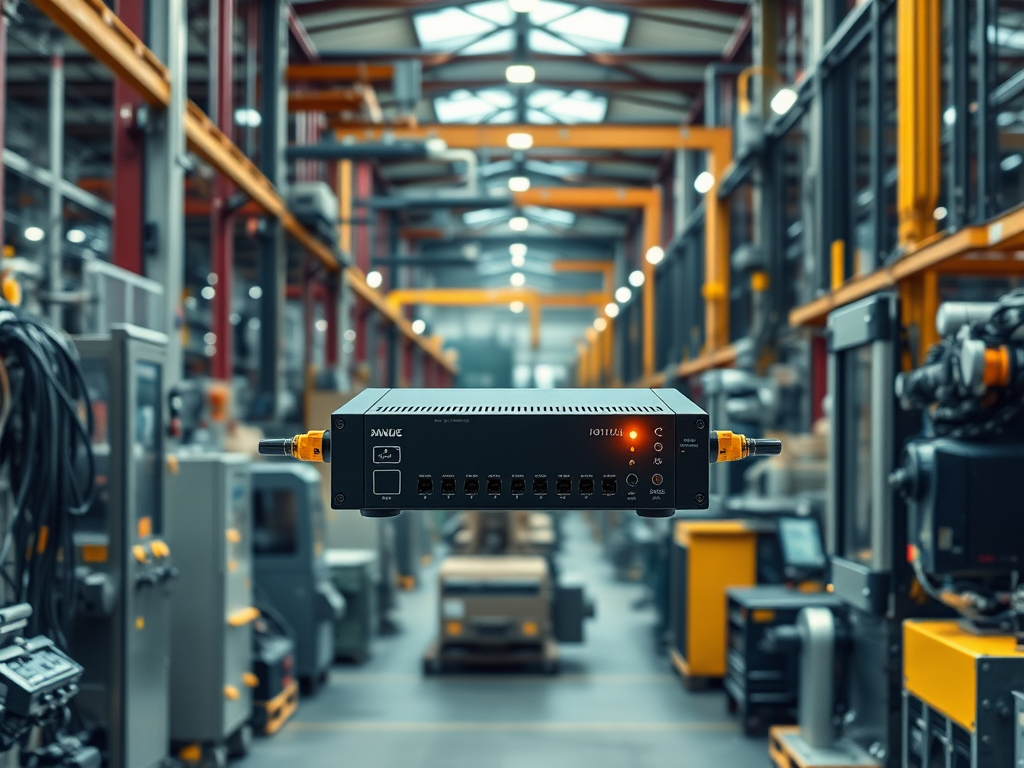
Most factories are not fully “smart factories.” They are a combination of legacy assets that remain critical, newer equipment with restricted networks, vendor skids with limited documentation, quality systems requiring trusted data, IT teams enforcing security controls, and business stakeholders expecting results on very short timelines.
So when someone asks, “What is the best IIoT hardware for 2026?” the underlying question is usually more practical: “Which industrial device should be used to connect plant equipment safely, without disrupting what is already operating correctly?”
That is the purpose of this guide.
There are no sponsors, affiliate links, or promotional intent. It is simply a practical shortlist of industrial gateways and edge devices that should be considered when the goal is to connect machines, acquire data reliably, and scale across multiple sites in a manageable way.
Why Do These Devices Matter?
It is common to hear that an IIoT gateway is “just a computer in a box.”
That description is not entirely wrong, but it does not capture the function these devices serve in real production settings.
In industrial environments, a gateway typically supports six critical needs:
1. Connect to machines (even when connectivity was never part of the original design)
Most sites operate within a diverse protocol landscape:
- PLCs using EtherNet/IP, PROFINET, Modbus TCP
- Serial devices (RS-232 and RS-485 remain common in 2026)
- Legacy SCADA connections
- Vendor skids with isolated networking constraints
- Custom interfaces built years ago, often without current internal expertise
The gateway acts as a protocol bridge. It speaks machine-side protocols on one interface and modern IT or cloud-friendly protocols on the other.
This remains essential in 2026 because not all equipment is designed for MQTT or API-based connectivity.
2. Buffer data when networks fail (which occurs more often than expected)
A reality of industrial environments is that networks do fail, including modern networks.
Switches reboot. Firewall policies change. Wireless links drop. Maintenance activities introduce unplanned disconnections. Planned outages can exceed expected durations.
A well-designed gateway reduces risk by:
- Buffering messages locally during outages
- Retrying transmissions in a controlled way
- Protecting against data loss for critical signals
Because operational trust is quickly damaged when dashboards show missing production data. In many cases, production occurred normally. The data simply did not reach the destination.
3. Improve security at the OT boundary
Cybersecurity is no longer optional in OT environments.
Gateways can provide a controlled point of enforcement for certificates, encrypted communication, network segmentation, role-based access, and managed remote access.
In practice, gateways often become the managed boundary between machine networks, plant networks, DMZ layers, and cloud ingestion services.
While this can add complexity, it is significantly preferable to uncontrolled or ad hoc connectivity methods.
4. Normalize and contextualize raw signals
Collecting raw tags is straightforward. Turning them into meaningful and reusable data is more difficult.
For example, a signal such as Tag_1023 = 1 may represent:
- Machine running
- Fault condition
- Material starved
- Safety door open
- A historical implementation detail that no longer reflects current meaning
A gateway can support data normalization by applying naming standards, mapping signals to asset models, and structuring outputs to align with a Unified Namespace approach.
This is where raw signals begin to become usable information.
5. Enable remote support in a controlled manner
Industrial sites often require vendor support. The practical question is not whether remote access will exist, but how it will be controlled.
Gateways such as Ewon are widely adopted because they enable auditable and restricted vendor access for troubleshooting and maintenance.
When governed correctly, downtime is reduced. When unmanaged, remote access becomes a major security exposure.
6. Enable scalable deployment and operational support
Connecting a single machine is typically manageable. Connecting hundreds of machines across multiple sites introduces new requirements.
At scale, the focus shifts to:
- Fleet management
- Remote updates and patching
- Device monitoring and diagnostics
- Logging and observability
- Standard images and repeatable deployment models
- Hardware replacement and lifecycle processes
In many industrial programs, the most important question is not protocol support. It is whether the gateway can be operated effectively across the enterprise.
Top 10 IIoT Gateways for 2026
This list is not ranked. It reflects what typically matters most in production environments: reliability, connectivity versatility, security readiness, lifecycle support, and deployment practicality.
1. Red Lion FlexEdge DA50D

This platform is often a strong choice in brownfield environments due to its practical flexibility.
Why it matters:
- Strong capability in mixed-protocol environments
- Modular design supports changing requirements
- Fits well within edge data hub architectures
Best fit:
- Bridging legacy PLCs to modern platforms
- Acting as a plant-level concentrator
- Enabling modernization without replacing control systems
Perspective: For general plant connectivity, this is frequently a strong starting point for evaluation.
2. Moxa UC-3400A Series

A rugged industrial edge gateway, particularly well suited for environments requiring wireless options.
Why it matters:
- Designed for harsh industrial conditions
- Strong wireless support (4G/5G/Wi-Fi)
- Long lifecycle support
Best fit:
- Distributed assets across large sites
- Remote plant areas
- Locations where cabling is impractical
Perspective: Many devices perform well in controlled tests. This family tends to remain stable in real production conditions.
3. Digi IX40 (5G industrial router + edge compute)

When cellular connectivity is required, visibility and lifecycle management are critical.
Why it matters:
- Designed for industrial LTE/5G deployments
- Strong remote management capabilities
- Well aligned to distributed monitoring architectures
Best fit:
- Remote pumps, tanks, or utilities
- Temporary installations
- Hard-to-wire deployments
Perspective: Cellular connectivity resolves many problems, but it must be governed from day one to avoid unmanaged sprawl.
4. Cisco IR829 (industrial router/gateway)

This device often aligns well with enterprise IT standards and governance models.
Why it matters:
- Strong networking capabilities
- Easier integration with IT security standards
- Often simpler to approve in regulated enterprises
Best fit:
- IT/OT boundary deployments
- Segmented architectures
- Network-governed environments
Perspective: Approval and alignment with governance can be as important as technical capabilities.
5. HMS Ewon Flexy 205

A widely deployed option for remote access and OEM support use cases.
Why it matters:
- Established remote support approach
- Commonly adopted across industries
- Strong fit for vendor-managed equipment
Best fit:
- Packaging lines
- OEM equipment deployments
- Remote troubleshooting needs
Perspective: Remote access provides immediate value, but requires strong governance to remain secure.
6. Siemens SIMATIC IOT2050

An effective option for Siemens-heavy environments where integration and familiarity matter.
Why it matters:
- Designed as an OT-to-IT bridge
- Strong adoption within Siemens automation ecosystems
- Suitable for light edge workloads
Best fit:
- Siemens-standard plants
- Structured automation environments
- Edge integration applications
Perspective: In multi-vendor realities, alignment with existing standards reduces friction.
7. Moxa UC-4400A Series

A higher-capacity option for situations requiring more compute resources.
Why it matters:
- Suitable for more complex edge workloads
- Supports advanced conversion and processing
- Benefits standardization when Moxa is already adopted
Best fit:
- Heavier edge applications
- Multi-protocol conversion
- Complex remote deployments
Perspective: Standardizing on fewer device families can significantly reduce long-term engineering overhead.
8. Sierra Wireless AirLink FX30

A compact industrial device suited for cellular use cases with edge programmability.
Why it matters:
- Small footprint
- Rugged hardware design
- Suitable for field deployments
Best fit:
- Remote monitoring
- Smaller industrial deployments
- Assets with limited infrastructure
Perspective: Many use cases require reliable, controlled connectivity more than feature depth.
9. Advantech ECU Series (ECU-1051)

A practical “industrial PC gateway” option found across many sites.
Why it matters:
- Broad industrial gateway portfolio
- Common factory deployment pattern
- Strong serial and Ethernet combinations
Best fit:
- Cost-sensitive rollouts
- Basic protocol acquisition needs
- Straightforward data acquisition scenarios
Perspective: The best option is often the one that can be repeated at scale with minimal operational friction.
10. Sierra Wireless RV50X (industrial LTE router)

Included to clarify a common distinction: sometimes only routing is required, not edge execution.
Why it matters:
- Reliable LTE routing focus
- Strong fit for fixed remote assets
- Stable and simple operation model
Best fit:
- Connectivity-only scenarios
- Infrastructure monitoring
- High-uptime deployments
Perspective: Industrial routers remain important when edge logic is handled elsewhere.
Key Criteria When Selecting an IIoT Gateway in 2026
For production deployment, these questions are typically the most relevant:
1. Can it withstand industrial conditions?
Heat, vibration, electrical noise, and non-ideal cabinet environments.
2. Can it be managed at scale?
Remote diagnostics, patching, and monitoring are essential at enterprise scale.
3. Does it align with the security model?
Certificates, segmentation, least-privilege access, and auditability.
4. Does it support the real protocol landscape?
Not the protocols in strategy slides. The protocols running in current operations.
5. Will it remain supported for 5–10 years?
Industrial lifecycle expectations require long-term support strategies.
Final Thoughts
Many organizations purchase gateways because the effort feels like progress. However, value is not achieved without investment in:
- Naming and data standards
- Clear ownership and operating processes
- Support models and escalation paths
- Data governance
A practical conclusion is this: Connectivity alone is not success. Operational ownership is success.
Leave a Comment