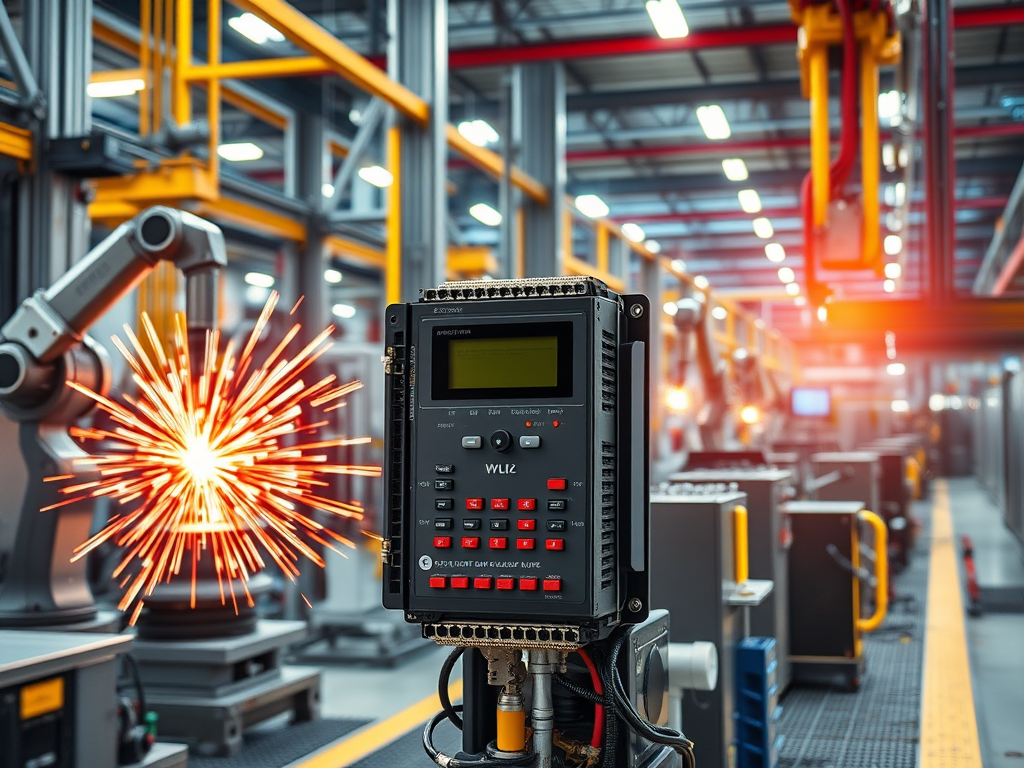
Let’s start at the beginning: what’s a PLC, and why does it matter so much in smart factories and IIoT (Industrial Internet of Things) setups?
The Basics: What Is a PLC?
A PLC, or Programmable Logic Controller, is basically the workhorse of industrial automation. Think of it as a rugged, specialized computer that sits right next to the machines on the plant floor. Its job? To monitor sensors, control motors and valves, and make split-second decisions to keep production running safely and efficiently.
PLCs are everywhere in manufacturing. If you walk into a factory — whether it’s making cars, medicine, food, or microchips — odds are there’s a PLC nearby, quietly running the show. They’re built to survive heat, dust, vibration, electrical noise, and whatever else a factory can throw at them.
Here’s a simple example: On a bottling line, a PLC might watch for a bottle arriving at a filling station, open a valve to fill it, then close the valve and signal a conveyor to move the next bottle into place. All of this happens in milliseconds, thousands of times a day.
Why Are PLCs So Central to IIoT?
Now, when we talk about IIoT — connecting machines, data, and people — PLCs are the starting point. They’re where the real-time data originates. In other words, all the fancy dashboards, AI, and cloud analytics you hear about in Industry 4.0 are useless without the raw signals coming from these controllers.
In a modern IIoT architecture, PLCs connect to higher-level systems using secure, standardized protocols. The most common ones I’ve seen are OPC UA and MQTT. These protocols let PLCs “speak” to SCADA (Supervisory Control and Data Acquisition), DCS (Distributed Control Systems), historians, MES (Manufacturing Execution Systems), and cloud platforms — without custom code or risky hacks. This is what lets you scale from a single line to an entire global network, securely and reliably.
Real-Life: PLCs in Action
Let me give you a concrete example from my own work. At a large manufacturing, we needed to connect over 5000+ machines — most of them controlled by PLCs — and stream data to the cloud for real-time monitoring and analytics. Every day, those PLCs generated about 100+ million data points, covering everything from temperature and pressure to batch status and alarms.
We used a standard architecture: PLCs connected to edge gateways. These gateways spoke OPC UA to collect data from dozens of PLC brands, then pushed that data into a unified namespace — basically a structured data model that makes it easy to find the right information, no matter the site or equipment. From there, data flowed to cloud platforms for analytics, dashboards, and even AI-driven predictive maintenance.
Another example: In an automotive plant, PLCs controlled robotic welders and conveyors. By connecting the PLCs to an MES system using OPC UA, we could track production in real time, spot bottlenecks, and even trace quality issues back to specific machines or shifts. This wasn’t just theory — it helped cut downtime and improved first-pass yield, which the plant manager cared about a lot.
How PLCs Communicate in IIoT
Communication is everything in IIoT. Here’s how it usually works in the field:
- PLCs connect to edge devices or gateways using Ethernet (or sometimes older serial protocols, if you’re dealing with legacy equipment).
- Edge gateways “translate” the raw PLC data into standardized formats using OPC UA or MQTT. This is crucial for cybersecurity and scalability.
- From the gateway, data is streamed to historians (like PI or IP.21), MES, or directly to the cloud for analytics and dashboards.
- In regulated industries, this architecture is validated for compliance, with strict controls on data integrity and cybersecurity (think GxP, FDA, etc.).
Honest Opinion: The Good, the Bad, and the Ugly
Here’s the honest truth: PLCs are both the backbone and the bottleneck of digital transformation in manufacturing. They’re reliable and proven, but integrating hundreds (or thousands) of them — especially across different brands, ages, and protocols — is never as easy as the brochures claim.
I’ve seen projects where a single, undocumented PLC program held up a multi-million-dollar rollout for weeks. On the flip side, when you get the architecture right — with standard protocols, good documentation, and clear data models — PLCs become a launchpad for everything else: real-time dashboards, predictive analytics, even mobile apps for operators on the shop floor.
That’s why, for anyone new to IIoT or smart manufacturing, I always say: start by understanding your PLC landscape. Know what you have, how it’s programmed, and how it communicates. Everything else builds on that foundation.
Wrapping Up
So, in plain English: PLCs are the brains of the machines. In IIoT, they’re also the eyes and ears, feeding data into the digital nervous system of the factory. Connecting them — securely, scalably, and with the right protocols — is the first step to making plants smarter, simpler, and more connected.
If you’re just starting out, don’t be afraid to ask “dumb” questions about PLCs. I still do, and I’ve been at this for over 20 years. The tech keeps changing, but the basics stay the same.
Leave a Comment