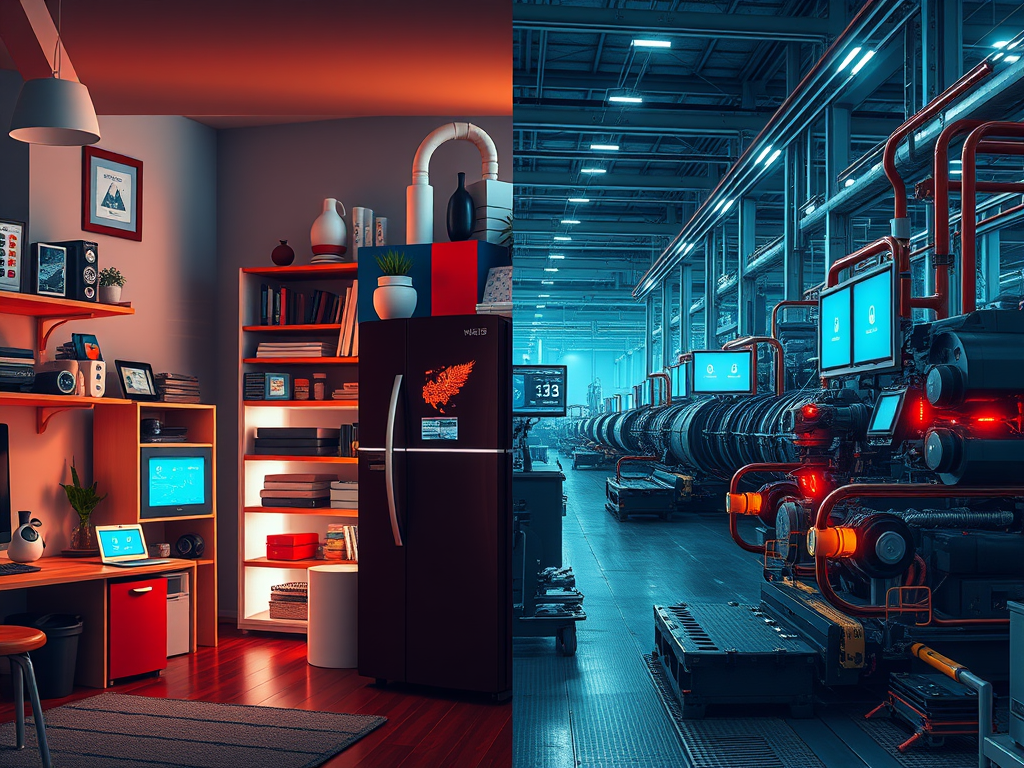
I get asked a lot about the difference between IoT and IIoT, especially from folks who are new to manufacturing or are coming from IT. It’s a fair question. On the surface, both involve connecting “things” to the internet, collecting data, and doing something useful with it. But once you’ve spent some time in a plant or tried to roll out a multi-site IIoT platform, you realize the differences are real — and they matter.
So, let’s break this down, with a few stories from the trenches.
What Is IoT, and How Is IIoT Different?
- IoT (Internet of Things) is a broad term. It covers everything from smart thermostats in your house to connected cars and fitness trackers. The focus is usually on convenience, automation, and sometimes a bit of fun. Think about your smart fridge telling you you’re out of milk, or your watch tracking your steps.
- IIoT (Industrial Internet of Things) is a more serious beast. Here, we’re talking about connecting machines, sensors, and control systems in factories, chemical plants, mines, and similar places. The goals are different: improve efficiency, reduce downtime, keep people safe, and meet strict quality and compliance standards. In other words, if your home IoT system crashes, you might have to reset your router. If your IIoT system fails, you might stop a production line, lose a batch, or even trigger a safety incident.
The Stakes: Data Integrity, Security, and Reliability
This is where the biggest difference comes in. IIoT has to deal with much higher demands for data accuracy, security, and reliability. In my experience, you can’t afford to lose a single data point from a critical process — especially in regulated industries like food or pharma. You have to prove to auditors that their data couldn’t be tampered with and was always available, even during network outages. You have to build in store-and-forward, edge buffering, and failover protections, so that even if the network goes down for days, nothing is lost or corrupted.
IoT at home? If your Wi-Fi drops and your smart bulb goes offline, it’s annoying, but not a disaster.
Compliance and Quality: Not Just a Checkbox
Another difference that keeps me up at night is compliance. In IIoT, you’ve got to meet all sorts of regulations: GxP, FDA 21 CFR Part 11, data integrity standards, and more. That means every layer — from the shop floor to the cloud — needs robust security, traceability, and auditability. We design architectures with role-based access control, encryption everywhere, and audit trails that can stand up to the toughest inspections.
In contrast, consumer IoT usually isn’t built for that level of scrutiny.
Scale and Complexity: More Than Just More Devices
IIoT isn’t just “IoT with more sensors.” It’s about handling thousands of machines, millions of data points, and integrating with legacy equipment that sometimes predates the internet itself. I’ve seen platforms supporting thousands of machines across dozens of sites — all needing to speak the same language and follow the same rules.
Consumer IoT can get big, but you rarely see this kind of scale, especially with the need for real-time data and high availability.
OT and IT: Two Worlds Colliding
Here’s something that surprises a lot of IT folks: IIoT sits right at the intersection of OT (Operational Technology) and IT (Information Technology). OT is all about keeping the plant running — think PLCs, SCADA, DCS. IT is about business systems, analytics, and cloud. Historically, these teams barely talked. IIoT forces them to work together. This convergence is messy (trust me), but it’s also where the magic happens: you get real-time insights, predictive maintenance, and automation that just wasn’t possible before.
Data Context and Unified Namespace
One thing I wish we’d had years ago: the Unified Namespace (UNS). In IIoT, having a single, contextualized data layer is a game-changer. It means you can standardize naming, enrich data with metadata, and onboard new assets without reinventing the wheel every time. This eliminates data silos and provides a single source of truth for analytics and AI.
Consumer IoT rarely needs this level of standardization or context.
Protocols and Architectures: Why MQTT and OPC UA Matter
In IIoT, open industrial protocols are your friend. We use OPC UA, MQTT (often with Sparkplug B), and REST APIs to connect everything from old PLCs to new cloud platforms. These protocols are designed for reliability, low latency, and security — exactly what you need on a plant floor. For example, MQTT’s publish-subscribe model lets you decouple systems and scale easily, while OPC UA provides rich, secure data models.
Opinion: IIoT Is Harder, But More Rewarding
Here’s my take, after years in the field: IIoT is a lot harder than consumer IoT. The stakes are higher, the systems are more complex, and the need for compliance and reliability is relentless. But when you get it right, you unlock real value — safer plants, less downtime, better quality, and even sustainability gains. It’s not about flashy gadgets; it’s about making things work, every day, at scale.
Wrapping Up
So, the next time someone says “IoT and IIoT are basically the same,” you’ll know better. IIoT is about industrial-scale reliability, compliance, and integration — and it takes a whole different mindset and toolkit to do it right. If you’re thinking about jumping in, be ready for a challenge, but know that the impact you can make is huge.
Leave a Comment