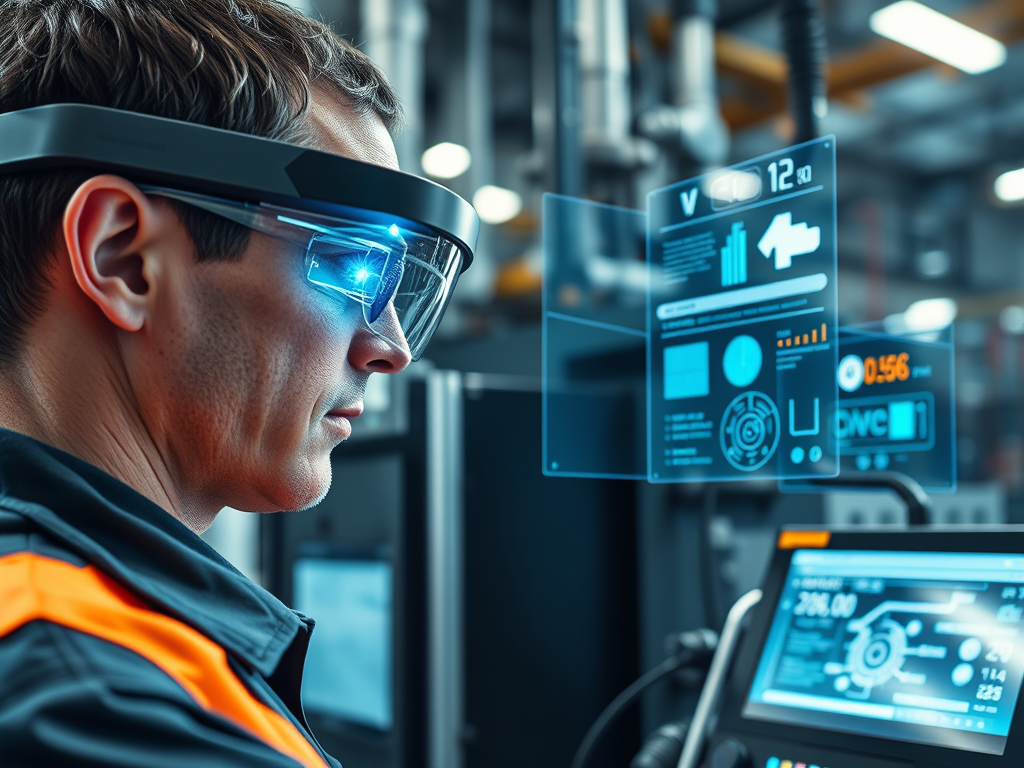
Let’s talk about AR (Augmented Reality) and VR (Virtual Reality) in the world of Industrial IoT. I’ve been hands-on with both — Google Glass, HoloLens, and their cousins — and I want to share what I’ve actually seen work, what’s still clunky, and where I think it’s all heading.
Why Bother Combining AR/VR and IIoT?
First, quick definitions in my own words: AR is about overlaying digital info onto the real world — think of digital work instructions floating in your field of view while you’re fixing a machine. VR, on the other hand, puts you in a fully virtual world — like a digital twin of your plant where you can “walk” around and practice tasks without touching real equipment.
IIoT (Industrial IoT) is about connecting physical devices (machines, sensors, PLCs, etc.) to the digital world. The magic happens when you bring these together. Now, not only can you see real-time machine data, but you can also experience it — in context, hands-free, right where the work is happening.
What I’ve Actually Seen Work
1. Remote Expert Support (AR + IIoT)
This is the “killer app” for AR in industry so far. I’ve set up projects where someone on the plant floor wears smart glasses (HoloLens), calls a remote expert, and shares their view in real time. The expert can draw arrows, send PDFs, or even overlay digital instructions right onto the operator’s field of view. You can do this while both hands are free, which is a big deal for safety and efficiency.
The biggest impact? Faster troubleshooting — I’ve seen mean time to resolution drop by 30–50% for complex technical issues. Less travel for experts, too. Instead of waiting days for a specialist to fly in, you get help in minutes. It’s not science fiction — it’s just Teams or Zoom with a twist, but it works because it fits the real workflow and is easy to use.
2. Real-Time Data in Your Line of Sight
Here’s where IIoT comes in. Imagine you’re doing maintenance, and you see live sensor data, maintenance history, or alarm states right in your glasses — not on a clipboard, not on a wall-mounted HMI, but exactly where you’re working. In a couple of my projects, we integrated historian and MES data (like OEE dashboards, batch status, or even “golden batch” parameters) into AR overlays, so you can check process conditions on the spot. It’s a small thing, but it cuts down on walking back and forth, and it helps you catch problems before they become big.
3. Training and Virtual Walkthroughs (VR + IIoT)
VR is great for immersive training. I’ve seen it used to simulate rare or risky scenarios — like a plant startup, shutdown, or emergency response — without risking actual equipment or product. When you connect your VR environment to real plant data (via IIoT), you can train on actual scenarios, not just canned examples. Operators get to “fail safely,” and you can even track their progress and skills.
One honest opinion: VR is still a bit heavy for day-to-day operations. It shines in training, onboarding, or when you want to visualize a digital twin. But for most shop floor tasks, AR is less intrusive and more practical.
What’s Still Hard (and What I Learned the Hard Way)
- Connectivity is everything. If your Wi-Fi is spotty in the plant, AR/VR will frustrate users. Invest in industrial-grade wireless first.
- Device Management is real work. You need an MDM (Mobile Device Management) platform. Otherwise, updating, securing, and tracking devices becomes a mess. We used Intune and sometimes ArborXR for non-Microsoft devices.
- Security and Privacy. Smart glasses are cameras on people’s heads. You need clear policies about where they can be used, how data is stored, and who can access video streams. Don’t skip this, especially if you’re in a regulated environment.
- User Adoption. Not everyone loves wearing glasses, especially if they’re heavy or don’t fit well. In my experience, early adopters are excited, but you need to invest in training, support, and (sometimes) just listening to complaints about comfort and battery life.
- Integration with IIoT Platforms. The real value comes when you connect AR/VR to your existing IIoT stack — historians, MES, ERP, etc. That takes planning. Out-of-the-box demos are nice, but real-world integration is always more work than you expect.
Some Emerging (and Promising) Ideas
- 3D CAD and Digital Twin Visualization. Imagine pulling up a 3D model of a machine, overlaid on the real asset, and seeing live IIoT data mapped to each component. I’ve seen early pilots — it’s powerful for troubleshooting and training, but you need good CAD data and a solid integration layer.
- Automated Downtime Analysis. With AI and IIoT, you can classify downtime automatically. Combine that with AR — now, when a line goes down, the operator sees likely causes and step-by-step instructions, right in their glasses.
- Edge + Cloud Hybrid. For AR/VR to scale, you need a mix of edge (local, fast, secure) and cloud (scalable, analytics, collaboration). This is especially true for video and AI-heavy applications — you don’t want to overload your network or expose sensitive data unnecessarily.
If You’re Thinking About Starting
Here’s what’s worked for me, in plain English:
- Start with a real pain point. Don’t do AR/VR because it’s cool. Do it because you have a problem (like slow troubleshooting, knowledge gaps, or hard-to-train tasks).
- Pilot, but plan for scale. Run a small proof of concept, but think ahead about device management, security, and how you’ll support users after go-live.
- Get buy-in from both IT and OT. You need both to make this work — IT for security and integration, OT for real-world needs and adoption.
- Measure impact. Track metrics like downtime reduction, training time, first-time fix rate. If you can’t show value, it won’t last.
My Honest Take
AR and VR, when combined with IIoT, are not magic bullets. They’re tools — sometimes game-changing, sometimes just “nice to have.” The real trick is making them fit the way people actually work. In my experience, the projects that succeed are the ones that solve a real problem, are easy to use, and don’t try to do too much at once. And honestly, sometimes the simplest solution (like a good old video call) is the best starting point.
But when you get it right — when the tech disappears and people just get their job done faster, safer, and with less stress — that’s when you know you’re onto something real.
Leave a Comment