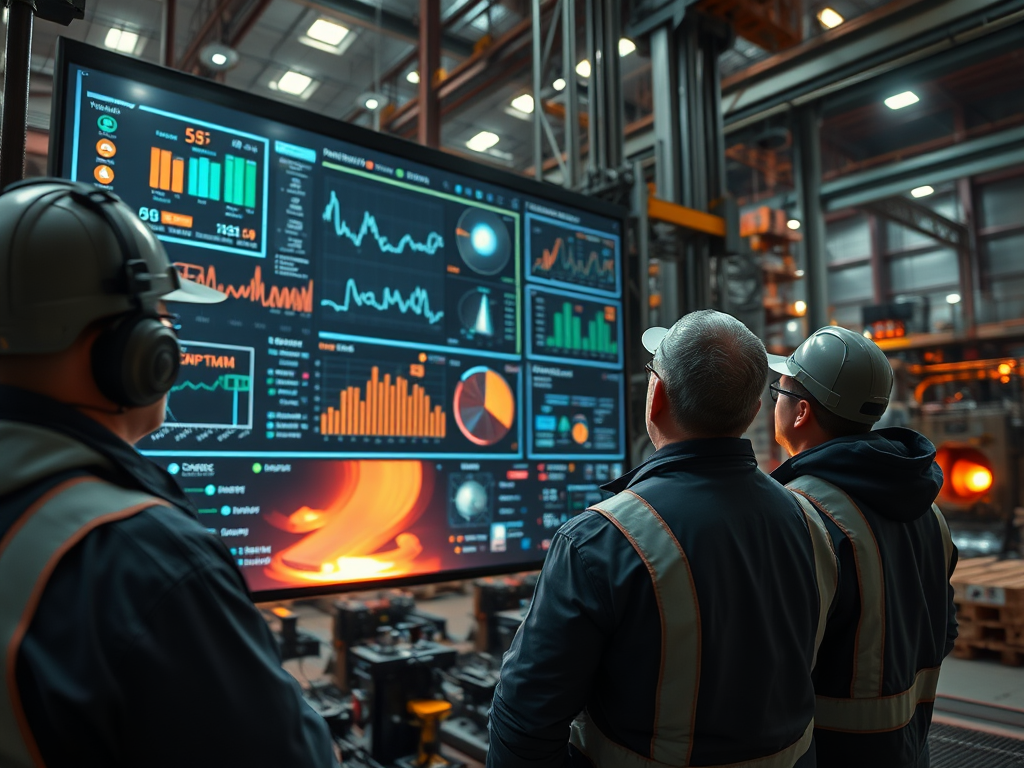
If you want to understand what real-time intelligence really means in manufacturing, spend a day in a steel mill. I learned more about data, people, and decision-making in that noisy, hot, and relentless environment than in any classroom or conference room.
This story goes back to 2009, in Brazil, when my team and I implemented one of the first real-time operations centers I had ever seen in a plant, project called “Video Wall”. Back then, the term “IIoT” wasn’t part of our vocabulary yet — cloud wasn’t mainstream, and most systems lived entirely on-site. Still, what we built captured the spirit of what we now call Industrial IoT: connecting machines, systems, and people through live data to make better, faster decisions.
The Steel Mill: Where Data Never Sleeps
Steel mills are relentless. Unlike a discrete assembly plant, where you can pause a line to fix something, steelmaking is a continuous, high-temperature, high-risk process. You’ve got blast furnaces, casting lines, rolling mills — all moving tons of material every minute. If something goes wrong, you don’t just lose a few parts; you risk millions in scrap, lost production, or even safety incidents.
That’s why real-time data isn’t a “nice to have” — it’s survival. Operators, supervisors, and engineers all need to know what’s happening right now, not just what happened an hour ago. And this isn’t just about dashboards. It’s about connecting SCADA, PLCs, Historians, MES, and ERP in a way that gives everyone the same version of the truth — fast enough to act before a small glitch becomes a disaster.
The Big Challenge: Connecting Islands
The first thing that hit me was how fragmented everything was. Each area — blast furnace, caster, rolling mill — had its own systems, screens, and ways of working. Some lines ran on decades-old PLCs, others had shiny new HMIs. Data was everywhere, but often stuck in “islands”: historian databases, Excel sheets, even paper logs.
When we started the “Video Wall Operations Center” project at a major integrated steel producer in Brazil, the goal was simple: put all the critical production, quality, and asset data on one giant screen, in real time, for everyone to see and use. In practice? Not so simple. We had to use and integrate SAP MII with Historian, SCADA, MES, and ERP — covering everything from furnace temperatures to coil tracking to delivery schedules. And it all had to be live, accurate, and reliable enough for people to make real decisions on the spot.


What Real-Time Intelligence Actually Looks Like
Here’s what we built, and why it mattered:
- Centralized, Live Dashboards: The video wall showed KPIs for every process — tons produced, quality yields, equipment status, and even GPS-tracked material movements. Operators could spot a bottleneck or quality drift before it hit the next stage. When a caster slowed down, everyone knew, and upstream and downstream teams could adjust immediately.
- Integrated Data, End-to-End: We connected SAP MII to SCADA, PLCs, and Historian (OSISoft PI). This meant we could pull real-time process signals, contextualize them to work orders, and push the results up to ERP for planning and scheduling. No more waiting for end-of-shift reports — shift supervisors could see how actual output compared to plan, hour by hour.
- Actionable Alerts: The system flagged deviations — like temperature out of spec or equipment downtime — with live alerts. Instead of hunting through logs, maintenance and quality teams got notified instantly, so they could act before a small issue became a big one.
- OEE and Asset Monitoring: We tracked Overall Equipment Effectiveness (OEE) in real time, breaking down losses by performance, quality, and availability. For example, if a rolling mill was running slow due to minor stops, it showed up immediately — not days later in a monthly report.
- Collaboration Across Teams: By putting everyone (production, logistics, maintenance, quality) in front of the same data, we broke down silos. Decisions got faster, meetings got shorter, and finger-pointing went down. One supervisor told me, “Before, we had two-hour meetings to find the root cause. Now, we have half-hour meetings to decide what to do next.”


What Worked — And What Didn’t
What Worked:
- Real-Time Data Changed Behavior: When people could see problems as they happened, they stopped blaming each other and started fixing things. For example, when a coil was delayed in shipping, the logistics team could see exactly where it was stuck — and why.
- Standardization Brought Clarity: We enforced common data models and integration templates. This cut configuration errors and made it easier to roll out improvements across multiple production areas. Templates for historian integration, OEE, and alerts became our secret weapon for scaling up.
- Contextualized Data: By tying process signals to specific work orders and batches, we made it possible to trace quality issues back to their source in minutes, not days. This was huge for compliance and customer claims.
What Didn’t (At First):
- Integration Was Hard: Every system spoke a different language. Historian integration, especially with OSISoft PI, was a pain. We had to optimize data retrieval (switching from single-tag to batch reads), tweak firewall settings, and sometimes get creative with middleware like SAP PCo and custom APIs.
- People Needed Training: Not everyone was ready to trust the new dashboards. Some operators kept their own paper logs “just in case.” It took time — and some quick wins — to build confidence.
- Data Quality Issues: Garbage in, garbage out. If a sensor was miscalibrated or a PLC was offline, the system still showed “live” data — but it wasn’t always right. We learned to build in data validation and alerts for missing or suspicious values.
- Cybersecurity: Connecting OT to IT opened new risks. We had to enforce role-based access, network segmentation, and encryption — or risk exposing critical systems to cyber threats. Zero Trust wasn’t just a buzzword; it was a must.
Lessons Learned (The Hard Way)
If I had to boil it down, here’s what steel taught me about real-time manufacturing intelligence:
- Start Small, Prove Value, Then Scale: We didn’t try to “boil the ocean.” The first version of the video wall covered one area. Once people saw results, the rest of the plant wanted in.
- Get IT, OT, and Business Talking: Integrations fail when teams don’t talk early and often. The best results came when operators, engineers, and IT sat together to define what “good” looked like.
- Templates and Standards Save Sanity: Every area thinks it’s unique, but 80% of the problems are the same. Standard templates for data integration, OEE, and alerts cut errors and sped up rollouts.
- Cybersecurity Can’t Be an Afterthought: We had a few scares. Now, I won’t connect anything to the enterprise without proper access controls and encryption.
- Context Is King: Data is only useful if it’s tied to the right work order, batch, or asset. Contextualization is what turns raw signals into actionable intelligence.
- Celebrate Small Wins: Early wins (like reducing manual data entry or cutting downtime by 5%) build trust and momentum for bigger changes.
One Honest Opinion
Here’s the unpopular truth: Real-time intelligence is mostly about people, not technology. The hardest part isn’t wiring up PLCs or building dashboards — it’s getting people to trust the data, use it, and change how they work. You can have the best system in the world, but if operators don’t believe what they see, nothing changes.
That’s why I always start with the people who’ll use the system daily. Show them how it solves their headaches, listen to their feedback, and let them own the solution. When you do that, the tech just becomes an enabler — not the main event.
Looking Back
That project — a real-time operations center in a Brazilian steel mill — won awards and remains one of the most meaningful things I’ve built. It wasn’t called IIoT back then, but the essence was there: connectivity, context, and collaboration.
Today, as we talk about Industrial IoT, Unified Namespace, and cloud streaming, I see how far we’ve come — but also how much the early lessons still apply.
Real-time intelligence isn’t new. It’s just evolving — from video walls on factory floors to data lakes in the cloud. What matters most hasn’t changed: turning data into decisions, and decisions into action.

Leave a Comment